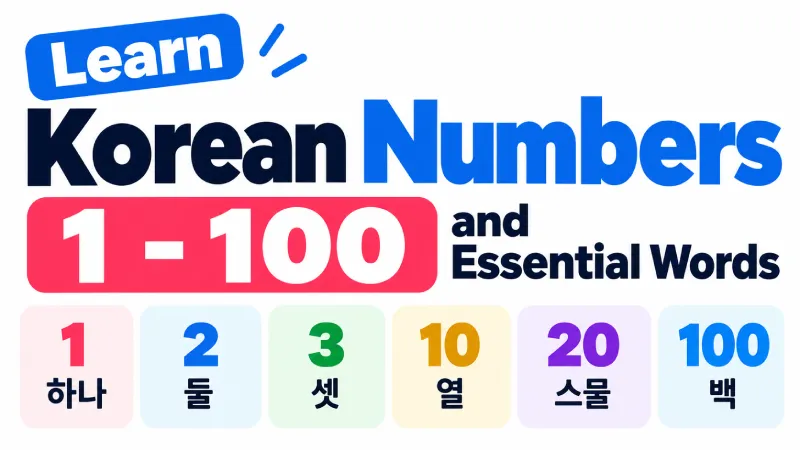
Learning Korean numbers 1-100 is one of the most useful skills for anyone studying Korean. You need numbers to talk about your age, tell the time, order food, shop in Korea, read prices, and understand dates.
But Korean has a surprising feature: two different number systems.
For example, the number 3 can be:
- 셋 (set) — Native Korean
- 삼 (sam) — Sino-Korean
Both mean three, but they are used in different situations.
In this beginner-friendly guide, you’ll learn both Korean number systems, study complete charts from 1 to 100, and discover how Koreans actually use numbers in everyday conversations.
You’ll also learn essential counting words, pronunciation, common mistakes, and practice exercises.
Level: Beginner (A1–A2)
Study time: 20–30 minutes
What you’ll learn: Native Korean numbers, Sino-Korean numbers, 1–100 charts, age, time, dates, prices, counters, and everyday expressions.
Table of Contents
- 1. Understanding the Two Korean Number Systems
- 2. Native Korean Numbers: 1 to 100
- 3. Sino-Korean Numbers: 1 to 100
- 4. Complete Korean Numbers 1–100 Chart
- 5. Counting Objects in Korean: Essential Counter Words
- 6. How to Tell Time in Korean
- 7. How to Say Dates and Ages in Korean
- 8. Shopping and Prices: Using Numbers in Real Life
- 9. Essential Korean Words for Everyday Situations
- 10. Common Mistakes When Learning Korean Numbers
- 11. Korean Numbers Practice Quiz
- 12. Frequently Asked Questions About Korean Numbers
- Final Review: Master Korean Numbers 1–100
1. Understanding the Two Korean Number Systems
Korean uses two number systems: Native Korean numbers and Sino-Korean numbers.
Native Korean numbers are traditional Korean words such as 하나, 둘, 셋, and 넷.
Sino-Korean numbers are based on Chinese-derived number words such as 일, 이, 삼, and 사.
You cannot simply choose either system in every situation. The correct choice depends on what you are counting.
Native Korean Numbers
Native Korean numbers are commonly used for counting objects, people, animals, and hours on the clock. They are also used when stating someone’s age with 살.
Examples:
사과 세 개 — Three apples
🔊 Listen: 사과 세 개
친구 두 명 — Two friends
🔊 Listen: 친구 두 명
다섯 시 — Five o’clock
🔊 Listen: 다섯 시
스무 살 — Twenty years old
🔊 Listen: 스무 살
Notice that some Native Korean numbers change their form before counting words. You’ll learn this important rule later.
Sino-Korean Numbers
Sino-Korean numbers are commonly used for dates, prices, minutes, phone numbers, and many other numerical expressions.
Examples:
삼천 원 — 3,000 won
🔊 Listen: 삼천 원
십오 분 — Fifteen minutes
🔊 Listen: 십오 분
삼월 — March
🔊 Listen: 삼월
이십삼 번 — Number 23
🔊 Listen: 이십삼 번
Which Number System Should You Use?
| Situation | Number system | Example |
|---|---|---|
| Counting apples | Native | 사과 세 개 |
| Counting people | Native | 학생 두 명 |
| Age with 살 | Native | 스무 살 |
| Clock hours | Native | 세 시 |
| Clock minutes | Sino | 삼십 분 |
| Prices in won | Sino | 오천 원 |
| Calendar dates | Sino | 십월 삼일 |
| Phone numbers | Sino | 일, 이, 삼… |
| Bus route numbers | Sino | 이십 번 버스 |
| Floors of a building | Sino | 삼 층 |
Beginner tip: Don’t try to memorize both systems without context. Practice them with real objects and everyday situations.
2. Native Korean Numbers: 1 to 100
Start with the numbers used for counting people, animals, and many everyday objects.
Native Korean Numbers 1–10
| Number | Korean | Romanization |
|---|---|---|
| 1 | 하나 | hana |
| 2 | 둘 | dul |
| 3 | 셋 | set |
| 4 | 넷 | net |
| 5 | 다섯 | daseot |
| 6 | 여섯 | yeoseot |
| 7 | 일곱 | ilgop |
| 8 | 여덟 | yeodeol |
| 9 | 아홉 | ahop |
| 10 | 열 | yeol |
Listen and repeat each number.
🔊 Listen: 하나
🔊 Listen: 둘
🔊 Listen: 셋
🔊 Listen: 넷
🔊 Listen: 다섯
🔊 Listen: 여섯
🔊 Listen: 일곱
🔊 Listen: 여덟
🔊 Listen: 아홉
🔊 Listen: 열
You can practice by counting objects around you.
Native Korean Numbers 11–19
Numbers from 11 to 19 follow a simple pattern:
열 + number
For example:
열하나 — 11
🔊 Listen: 열하나
열둘 — 12
🔊 Listen: 열둘
열다섯 — 15
🔊 Listen: 열다섯
열아홉 — 19
🔊 Listen: 열아홉
Once you remember the numbers 1–10, learning 11–19 becomes easier.
Native Korean Tens: 20–90
Unlike Sino-Korean numbers, Native Korean tens have their own words.
| Number | Korean | Romanization |
|---|---|---|
| 10 | 열 | yeol |
| 20 | 스물 | seumul |
| 30 | 서른 | seoreun |
| 40 | 마흔 | maheun |
| 50 | 쉰 | swin |
| 60 | 예순 | yesun |
| 70 | 일흔 | ilheun |
| 80 | 여든 | yeodeun |
| 90 | 아흔 | aheun |
Practice these words:
🔊 Listen: 스물
🔊 Listen: 서른
🔊 Listen: 마흔
🔊 Listen: 쉰
🔊 Listen: 예순
🔊 Listen: 일흔
🔊 Listen: 여든
🔊 Listen: 아흔
How to Form Native Korean Numbers Above 20
Combine the tens word with the number from 1 to 9.
For example:
스물하나 — 21
🔊 Listen: 스물하나
서른둘 — 32
🔊 Listen: 서른둘
마흔다섯 — 45
🔊 Listen: 마흔다섯
쉰여덟 — 58
🔊 Listen: 쉰여덟
예순세 — 63? Not in standalone counting!
Be careful: the correct standalone number is 예순셋 (63). The shortened form 세 is used before certain counters.
🔊 Listen: 예순셋
Important: Native Korean numbers are normally used up to 99. In modern everyday Korean, 100 is expressed as 백, a Sino-Korean number.
3. Sino-Korean Numbers: 1 to 100
Sino-Korean numbers have a regular structure, making larger numbers easier to build.
Sino-Korean Numbers 1–10
| Number | Korean | Romanization |
|---|---|---|
| 1 | 일 | il |
| 2 | 이 | i |
| 3 | 삼 | sam |
| 4 | 사 | sa |
| 5 | 오 | o |
| 6 | 육 | yuk |
| 7 | 칠 | chil |
| 8 | 팔 | pal |
| 9 | 구 | gu |
| 10 | 십 | sip |
Listen and repeat:
🔊 Listen: 일
🔊 Listen: 이
🔊 Listen: 삼
🔊 Listen: 사
🔊 Listen: 오
🔊 Listen: 육
🔊 Listen: 칠
🔊 Listen: 팔
🔊 Listen: 구
🔊 Listen: 십
How to Build Numbers 11–99
The Sino-Korean system uses a consistent pattern.
For numbers 11–19:
십 + number
For example:
십일 — 11
🔊 Listen: 십일
십오 — 15
🔊 Listen: 십오
십구 — 19
🔊 Listen: 십구
For multiples of ten:
이십 — 20
🔊 Listen: 이십
삼십 — 30
🔊 Listen: 삼십
사십 — 40
🔊 Listen: 사십
For other numbers, combine the tens and ones:
이십삼 — 23
🔊 Listen: 이십삼
사십육 — 46
🔊 Listen: 사십육
구십구 — 99
🔊 Listen: 구십구
How to Say 100 in Korean
The number 100 is:
백 (baek)
🔊 Listen: 백
You do not normally say 일백 for 100 by itself. Just say 백.
The same system continues for larger numbers:
| Number | Korean |
|---|---|
| 100 | 백 |
| 200 | 이백 |
| 1,000 | 천 |
| 2,000 | 이천 |
| 10,000 | 만 |
🔊 Listen: 천
🔊 Listen: 만
Unlike English, Korean uses 만 (10,000) as a major counting unit.
4. Complete Korean Numbers 1–100 Chart
This chart compares both systems side by side.
How to use the chart: Read a row horizontally. The same number has two Korean forms, depending on how it is used.
Numbers 1–25
| Number | Sino-Korean | Native Korean |
|---|---|---|
| 1 | 일 | 하나 |
| 2 | 이 | 둘 |
| 3 | 삼 | 셋 |
| 4 | 사 | 넷 |
| 5 | 오 | 다섯 |
| 6 | 육 | 여섯 |
| 7 | 칠 | 일곱 |
| 8 | 팔 | 여덟 |
| 9 | 구 | 아홉 |
| 10 | 십 | 열 |
| 11 | 십일 | 열하나 |
| 12 | 십이 | 열둘 |
| 13 | 십삼 | 열셋 |
| 14 | 십사 | 열넷 |
| 15 | 십오 | 열다섯 |
| 16 | 십육 | 열여섯 |
| 17 | 십칠 | 열일곱 |
| 18 | 십팔 | 열여덟 |
| 19 | 십구 | 열아홉 |
| 20 | 이십 | 스물 |
| 21 | 이십일 | 스물하나 |
| 22 | 이십이 | 스물둘 |
| 23 | 이십삼 | 스물셋 |
| 24 | 이십사 | 스물넷 |
| 25 | 이십오 | 스물다섯 |
Numbers 26–50
| Number | Sino-Korean | Native Korean |
|---|---|---|
| 26 | 이십육 | 스물여섯 |
| 27 | 이십칠 | 스물일곱 |
| 28 | 이십팔 | 스물여덟 |
| 29 | 이십구 | 스물아홉 |
| 30 | 삼십 | 서른 |
| 31 | 삼십일 | 서른하나 |
| 32 | 삼십이 | 서른둘 |
| 33 | 삼십삼 | 서른셋 |
| 34 | 삼십사 | 서른넷 |
| 35 | 삼십오 | 서른다섯 |
| 36 | 삼십육 | 서른여섯 |
| 37 | 삼십칠 | 서른일곱 |
| 38 | 삼십팔 | 서른여덟 |
| 39 | 삼십구 | 서른아홉 |
| 40 | 사십 | 마흔 |
| 41 | 사십일 | 마흔하나 |
| 42 | 사십이 | 마흔둘 |
| 43 | 사십삼 | 마흔셋 |
| 44 | 사십사 | 마흔넷 |
| 45 | 사십오 | 마흔다섯 |
| 46 | 사십육 | 마흔여섯 |
| 47 | 사십칠 | 마흔일곱 |
| 48 | 사십팔 | 마흔여덟 |
| 49 | 사십구 | 마흔아홉 |
| 50 | 오십 | 쉰 |
Numbers 51–75
| Number | Sino-Korean | Native Korean |
|---|---|---|
| 51 | 오십일 | 쉰하나 |
| 52 | 오십이 | 쉰둘 |
| 53 | 오십삼 | 쉰셋 |
| 54 | 오십사 | 쉰넷 |
| 55 | 오십오 | 쉰다섯 |
| 56 | 오십육 | 쉰여섯 |
| 57 | 오십칠 | 쉰일곱 |
| 58 | 오십팔 | 쉰여덟 |
| 59 | 오십구 | 쉰아홉 |
| 60 | 육십 | 예순 |
| 61 | 육십일 | 예순하나 |
| 62 | 육십이 | 예순둘 |
| 63 | 육십삼 | 예순셋 |
| 64 | 육십사 | 예순넷 |
| 65 | 육십오 | 예순다섯 |
| 66 | 육십육 | 예순여섯 |
| 67 | 육십칠 | 예순일곱 |
| 68 | 육십팔 | 예순여덟 |
| 69 | 육십구 | 예순아홉 |
| 70 | 칠십 | 일흔 |
| 71 | 칠십일 | 일흔하나 |
| 72 | 칠십이 | 일흔둘 |
| 73 | 칠십삼 | 일흔셋 |
| 74 | 칠십사 | 일흔넷 |
| 75 | 칠십오 | 일흔다섯 |
Numbers 76–100
| Number | Sino-Korean | Native Korean |
|---|---|---|
| 76 | 칠십육 | 일흔여섯 |
| 77 | 칠십칠 | 일흔일곱 |
| 78 | 칠십팔 | 일흔여덟 |
| 79 | 칠십구 | 일흔아홉 |
| 80 | 팔십 | 여든 |
| 81 | 팔십일 | 여든하나 |
| 82 | 팔십이 | 여든둘 |
| 83 | 팔십삼 | 여든셋 |
| 84 | 팔십사 | 여든넷 |
| 85 | 팔십오 | 여든다섯 |
| 86 | 팔십육 | 여든여섯 |
| 87 | 팔십칠 | 여든일곱 |
| 88 | 팔십팔 | 여든여덟 |
| 89 | 팔십구 | 여든아홉 |
| 90 | 구십 | 아흔 |
| 91 | 구십일 | 아흔하나 |
| 92 | 구십이 | 아흔둘 |
| 93 | 구십삼 | 아흔셋 |
| 94 | 구십사 | 아흔넷 |
| 95 | 구십오 | 아흔다섯 |
| 96 | 구십육 | 아흔여섯 |
| 97 | 구십칠 | 아흔일곱 |
| 98 | 구십팔 | 아흔여덟 |
| 99 | 구십구 | 아흔아홉 |
| 100 | 백 | — |
Note: The dash at 100 means that everyday modern Korean uses 백, not an ordinary Native Korean equivalent. In traditional or specialized contexts, you may encounter older number forms, but beginners should learn 백.
Pronunciation Practice with Larger Numbers
🔊 Listen: 스물다섯
🔊 Listen: 이십오
🔊 Listen: 마흔여덟
🔊 Listen: 사십팔
🔊 Listen: 일흔둘
🔊 Listen: 칠십이
🔊 Listen: 아흔아홉
🔊 Listen: 구십구
Try identifying which number system you hear before checking the chart.
5. Counting Objects in Korean: Essential Counter Words
Korean does not always count objects by saying a number directly before a noun.
Instead, it often uses a counter, a word that identifies the type of thing being counted.
For example, English speakers say “three apples.”
In Korean, a natural expression is:
사과 세 개 — Three apples
🔊 Listen: 사과 세 개
Here:
- 사과 = apple
- 세 = three (shortened Native Korean form)
- 개 = general counter for objects
Why 하나, 둘, 셋, 넷 Change Before Counters
Some Native Korean numbers shorten when used directly before certain counters.
| Standalone number | Before a counter |
|---|---|
| 하나 | 한 |
| 둘 | 두 |
| 셋 | 세 |
| 넷 | 네 |
| 스물 | 스무 |
Compare these examples:
하나 — One
🔊 Listen: 하나
사과 한 개 — One apple
🔊 Listen: 사과 한 개
둘 — Two
🔊 Listen: 둘
커피 두 잔 — Two cups of coffee
🔊 Listen: 커피 두 잔
셋 — Three
🔊 Listen: 셋
학생 세 명 — Three students
🔊 Listen: 학생 세 명
넷 — Four
🔊 Listen: 넷
책 네 권 — Four books
🔊 Listen: 책 네 권
스물 — Twenty
🔊 Listen: 스물
스무 살 — Twenty years old
🔊 Listen: 스무 살
Important: Learn the number and its counter form together. You will hear these shortened forms constantly in everyday Korean.
Essential Korean Counters
The original KoreanMario numbers lesson included many counters. Here are the most useful ones for everyday situations.
| Counter | Used for | Example |
|---|---|---|
| 개 | General objects | 사과 세 개 |
| 명 | People | 학생 두 명 |
| 분 | People (honorific) | 손님 세 분 |
| 마리 | Animals | 고양이 두 마리 |
| 잔 | Cups/glasses | 커피 두 잔 |
| 병 | Bottles | 물 한 병 |
| 그릇 | Bowls | 밥 한 그릇 |
| 권 | Books | 책 세 권 |
| 장 | Sheets, tickets | 종이 한 장 |
| 대 | Vehicles/machines | 자동차 두 대 |
| 켤레 | Pairs of shoes | 신발 두 켤레 |
| 송이 | Flowers | 장미 한 송이 |
| 벌 | Clothing outfits | 양복 한 벌 |
| 살 | Age | 스무 살 |
| 시 | Clock hours | 세 시 |
| 시간 | Duration in hours | 두 시간 |
Listen to Counter Expressions
🔊 Listen: 학생 두 명
🔊 Listen: 손님 세 분
🔊 Listen: 고양이 두 마리
🔊 Listen: 물 한 병
🔊 Listen: 밥 한 그릇
🔊 Listen: 책 세 권
🔊 Listen: 종이 한 장
🔊 Listen: 자동차 두 대
🔊 Listen: 신발 두 켤레
🔊 Listen: 장미 한 송이
🔊 Listen: 양복 한 벌
🔊 Listen: 두 시간
Useful Counting Sentences
사과 세 개 주세요.
Three apples, please.
🔊 Listen: 사과 세 개 주세요.
커피 두 잔 주세요.
Two cups of coffee, please.
🔊 Listen: 커피 두 잔 주세요.
고양이 두 마리가 있어요.
I have two cats.
🔊 Listen: 고양이 두 마리가 있어요.
책 세 권을 샀어요.
I bought three books.
🔊 Listen: 책 세 권을 샀어요.
물 한 병 주세요.
One bottle of water, please.
🔊 Listen: 물 한 병 주세요.
6. How to Tell Time in Korean
Korean time expressions use both number systems in one sentence.
This is an important rule:
Native Korean numbers = Hours
Sino-Korean numbers = Minutes
Reading Hours in Korean
| Time | Korean |
|---|---|
| 1:00 | 한 시 |
| 2:00 | 두 시 |
| 3:00 | 세 시 |
| 4:00 | 네 시 |
| 5:00 | 다섯 시 |
| 6:00 | 여섯 시 |
| 7:00 | 일곱 시 |
| 8:00 | 여덟 시 |
| 9:00 | 아홉 시 |
| 10:00 | 열 시 |
| 11:00 | 열한 시 |
| 12:00 | 열두 시 |
Listen and practice:
🔊 Listen: 한 시
🔊 Listen: 두 시
🔊 Listen: 세 시
🔊 Listen: 네 시
🔊 Listen: 다섯 시
🔊 Listen: 여섯 시
🔊 Listen: 일곱 시
🔊 Listen: 여덟 시
🔊 Listen: 아홉 시
🔊 Listen: 열 시
🔊 Listen: 열한 시
🔊 Listen: 열두 시
Reading Minutes in Korean
Minutes use Sino-Korean numbers.
For example:
십오 분 — 15 minutes
🔊 Listen: 십오 분
삼십 분 — 30 minutes
🔊 Listen: 삼십 분
사십오 분 — 45 minutes
🔊 Listen: 사십오 분
Reading a Complete Time
| Digital time | Korean |
|---|---|
| 1:15 | 한 시 십오 분 |
| 2:27 | 두 시 이십칠 분 |
| 4:28 | 네 시 이십팔 분 |
| 6:35 | 여섯 시 삼십오 분 |
| 7:42 | 일곱 시 사십이 분 |
| 10:06 | 열 시 육 분 |
| 11:14 | 열한 시 십사 분 |
| 12:30 | 열두 시 삼십 분 |
🔊 Listen: 한 시 십오 분
🔊 Listen: 두 시 이십칠 분
🔊 Listen: 네 시 이십팔 분
🔊 Listen: 여섯 시 삼십오 분
🔊 Listen: 일곱 시 사십이 분
🔊 Listen: 열 시 육 분
🔊 Listen: 열한 시 십사 분
🔊 Listen: 열두 시 삼십 분
How to Ask for the Time
지금 몇 시예요?
What time is it now?
🔊 Listen: 지금 몇 시예요?
지금 세 시 반이에요.
It’s 3:30 now.
🔊 Listen: 지금 세 시 반이에요.
반 means “half,” so 세 시 반 is a natural way to say 3:30.
7. How to Say Dates and Ages in Korean
Dates and ages are another important reason to learn both Korean number systems.
Korean Dates Use Sino-Korean Numbers
Years, months, and calendar dates generally use Sino-Korean numbers.
For example:
2026년 — The year 2026
🔊 Listen: 이천이십육 년
10월 — October
🔊 Listen: 시월
8일 — The eighth day of the month
🔊 Listen: 팔일
2026년 10월 8일 — October 8, 2026
🔊 Listen: 이천이십육 년 시월 팔일
Notice that 10월 is pronounced 시월, not 십월. Another important exception is 6월, pronounced 유월.
🔊 Listen: 유월
Days of the Week
The KoreanMario lesson also introduced Korean weekdays. These are essential words for using a calendar.
| English | Korean |
|---|---|
| Monday | 월요일 |
| Tuesday | 화요일 |
| Wednesday | 수요일 |
| Thursday | 목요일 |
| Friday | 금요일 |
| Saturday | 토요일 |
| Sunday | 일요일 |
| Weekend | 주말 |
| Weekday | 평일 |
🔊 Listen: 월요일
🔊 Listen: 화요일
🔊 Listen: 수요일
🔊 Listen: 목요일
🔊 Listen: 금요일
🔊 Listen: 토요일
🔊 Listen: 일요일
🔊 Listen: 주말
🔊 Listen: 평일
How to Say Your Age in Korean
Age is commonly expressed using Native Korean numbers with 살.
저는 스무 살이에요.
I’m 20 years old.
🔊 Listen: 저는 스무 살이에요.
저는 스물다섯 살이에요.
I’m 25 years old.
🔊 Listen: 저는 스물다섯 살이에요.
저는 서른두 살이에요.
I’m 32 years old.
🔊 Listen: 저는 서른두 살이에요.
To ask someone’s age in everyday polite Korean, you may hear:
몇 살이에요?
How old are you?
🔊 Listen: 몇 살이에요?
Age can be a personal topic, so consider the situation before asking.
Culture note: South Korea generally uses international age in official and administrative contexts. Traditional Korean age expressions may still appear in informal conversation, so it’s useful to clarify which age system someone means.
8. Shopping and Prices: Using Numbers in Real Life
One of the easiest ways to practice Sino-Korean numbers is by reading prices.
Korean Currency: 원
The Korean currency is the won, written as 원.
Examples:
천 원 — 1,000 won
🔊 Listen: 천 원
오천 원 — 5,000 won
🔊 Listen: 오천 원
만 원 — 10,000 won
🔊 Listen: 만 원
이만 원 — 20,000 won
🔊 Listen: 이만 원
삼만 오천 원 — 35,000 won
🔊 Listen: 삼만 오천 원
Asking for a Price
이거 얼마예요?
How much is this?
🔊 Listen: 이거 얼마예요?
오천 원이에요.
It’s 5,000 won.
🔊 Listen: 오천 원이에요.
Ordering at a Café
A useful café conversation combines Native Korean numbers with counters and Sino-Korean numbers for prices.
Customer: 아메리카노 두 잔 주세요.
Two Americanos, please.
🔊 Listen: 아메리카노 두 잔 주세요.
Staff: 만 원입니다.
That’s 10,000 won.
🔊 Listen: 만 원입니다.
Customer: 카드로 계산할게요.
I’ll pay by card.
🔊 Listen: 카드로 계산할게요.
This is a practical example of using both number systems during a single interaction.
9. Essential Korean Words for Everyday Situations
The original KoreanMario lesson also included extensive vocabulary for places such as cafés, restaurants, shops, hospitals, schools, and homes.
For this numbers lesson, focus on essential words that help you understand quantities, money, time, and purchases.
Useful Numbers and Counting Vocabulary
| Korean | English |
|---|---|
| 숫자 | Number |
| 개 | General object counter |
| 명 | Person counter |
| 잔 | Cup/glass counter |
| 병 | Bottle counter |
| 시간 | Hour / duration |
| 분 | Minute |
| 시 | O’clock |
| 살 | Years old |
| 원 | Korean won |
| 가격 | Price |
| 계산 | Payment / calculation |
| 얼마 | How much |
| 몇 | How many / what number |
| 날짜 | Date |
| 생일 | Birthday |
Practice useful words:
🔊 Listen: 숫자
🔊 Listen: 가격
🔊 Listen: 계산
🔊 Listen: 얼마
🔊 Listen: 날짜
🔊 Listen: 생일
Essential Café, Restaurant, and Shopping Words
| Korean | English |
|---|---|
| 카페 | Café |
| 식당 | Restaurant |
| 메뉴 | Menu |
| 주문 | Order |
| 커피 | Coffee |
| 물 | Water |
| 우유 | Milk |
| 빵 | Bread |
| 가게 | Shop |
| 할인 | Discount |
| 영수증 | Receipt |
| 카드 | Card |
Here are some practical examples.
이거 두 개 주세요.
Two of these, please.
🔊 Listen: 이거 두 개 주세요.
할인돼요?
Is there a discount?
🔊 Listen: 할인돼요?
영수증 주세요.
Please give me a receipt.
🔊 Listen: 영수증 주세요.
세 명이에요.
There are three of us.
🔊 Listen: 세 명이에요.
These expressions are useful when shopping, ordering food, and traveling in Korea.
10. Common Mistakes When Learning Korean Numbers
Even learners who memorize the number charts often make mistakes when using numbers in sentences.
Mistake 1: Using Sino-Korean Numbers for Everything
Incorrect for ordinary clock hours:
삼 시
Correct:
세 시 — Three o’clock
🔊 Listen: 세 시
Clock hours use Native Korean numbers, while minutes use Sino-Korean numbers.
Mistake 2: Forgetting Shortened Counter Forms
Less natural:
사과 하나 개
Correct:
사과 한 개 — One apple
🔊 Listen: 사과 한 개
Before common counters, 하나 changes to 한.
The same principle applies to 둘 → 두, 셋 → 세, 넷 → 네, and 스물 → 스무.
Mistake 3: Using Native Numbers for Prices
Incorrect:
스물 원 for 20 won
Correct:
이십 원 — Twenty won
🔊 Listen: 이십 원
Prices generally use Sino-Korean numbers.
Mistake 4: Mixing Up the Number 20
Compare:
스물 — 20 (Native Korean)
🔊 Listen: 스물
이십 — 20 (Sino-Korean)
🔊 Listen: 이십
Both mean twenty, but they have different uses.
Mistake 5: Reading 6월 and 10월 Literally
Two month names have irregular pronunciations:
6월 = 유월
10월 = 시월
These are standard forms, not optional informal pronunciations.
11. Korean Numbers Practice Quiz
Test your knowledge before checking the answers.
Question 1
Which expression means “three apples”?
A. 사과 삼 개
B. 사과 세 개
C. 사과 셋 개
Question 2
How do you say 4:30 in Korean?
A. 사 시 서른 분
B. 네 시 삼십 분
C. 네 시 서른 분
Question 3
Which Korean number is 25 in the Native Korean system?
A. 이십오
B. 스물다섯
C. 스물오
Question 4
What is the correct way to say 10,000 won?
A. 십천 원
B. 열천 원
C. 만 원
Question 5
Which expression means “two students”?
A. 학생 두 명
B. 학생 이 명
C. 학생 둘 명
Question 6
How do you read 10월?
A. 십월
B. 시월
C. 열월
Question 7
How do you say “I’m 20 years old” using 살?
A. 저는 이십 살이에요.
B. 저는 스물 살이에요.
C. 저는 스무 살이에요.
Question 8
Which expression is correct for 7:15?
A. 칠 시 열다섯 분
B. 일곱 시 십오 분
C. 일곱 시 열다섯 분
Answer Key and Explanations
1. B — 사과 세 개
Use the Native Korean counter form 세 before 개.
2. B — 네 시 삼십 분
Hours use Native Korean; minutes use Sino-Korean.
3. B — 스물다섯
스물다섯 is the Native Korean number for 25.
4. C — 만 원
만 means 10,000.
5. A — 학생 두 명
두 is the shortened form of 둘 before the counter 명.
6. B — 시월
10월 is pronounced 시월.
7. C — 저는 스무 살이에요.
스물 changes to 스무 before the age counter 살.
8. B — 일곱 시 십오 분
일곱 is Native Korean, and 십오 is Sino-Korean.
Speaking Challenge
Try reading these numbers aloud without looking at the charts:
- 17 — Native Korean
- 28 — Sino-Korean
- 43 — Native Korean
- 65 — Sino-Korean
- 99 — Both systems
Answers:
- 열일곱
- 이십팔
- 마흔셋
- 육십오
- 아흔아홉 / 구십구
Now try using these numbers in a complete Korean sentence.
12. Frequently Asked Questions About Korean Numbers
Why does Korean have two number systems?
Korean preserves both traditional Native Korean number words and Chinese-derived Sino-Korean numbers. Over time, each system developed common uses in everyday language.
Which Korean numbers should beginners learn first?
Start with Native Korean numbers 1–10 and Sino-Korean numbers 1–10. Then learn the tens and practice numbers in everyday situations.
Are Korean numbers 1–100 difficult?
The Sino-Korean system is relatively regular. Native Korean numbers require more memorization, especially the unique words for 20, 30, 40, and the other tens.
How do you say 100 in Korean?
The ordinary modern Korean word for 100 is 백 (baek).
🔊 Listen: 백
Which numbers do Koreans use for age?
Native Korean numbers with 살 are common in everyday speech, such as 스무 살 and 서른 살. Sino-Korean numbers may also be used in more formal or administrative expressions with 세.
Which numbers do Koreans use for time?
Hours use Native Korean numbers, while minutes use Sino-Korean numbers.
For example:
여섯 시 삼십 분 — 6:30
🔊 Listen: 여섯 시 삼십 분
Final Review: Master Korean Numbers 1–100
You’ve now learned the two Korean number systems and how to use them in real situations.
Here’s a quick summary:
| Situation | Use |
|---|---|
| Counting everyday objects | Native Korean + counter |
| Counting people and animals | Native Korean + counter |
| Everyday age with 살 | Native Korean |
| Hours | Native Korean |
| Minutes | Sino-Korean |
| Dates | Sino-Korean |
| Prices | Sino-Korean |
| Phone numbers | Sino-Korean digit names |
| 100 and larger numbers | Generally Sino-Korean |
Your Final Speaking Practice
Read these sentences aloud.
사과 세 개 주세요.
Three apples, please.
🔊 Listen: 사과 세 개 주세요.
지금은 네 시 삼십 분이에요.
It’s 4:30 now.
🔊 Listen: 지금은 네 시 삼십 분이에요.
저는 스물다섯 살이에요.
I’m 25 years old.
🔊 Listen: 저는 스물다섯 살이에요.
이거 얼마예요?
How much is this?
🔊 Listen: 이거 얼마예요?
Continue Learning Korean
Now that you can count in Korean, practice introducing yourself and having simple conversations.
How to Introduce Yourself in Korean – Beginner’s Guide
Start conversations naturally with our Korean greetings lesson.
How to Say Hello in Korean – 15 Greetings for Beginners
Practice Korean numbers a little every day. Try reading prices, checking the time, and counting objects around you in Korean. With consistent practice, these expressions will become a natural part of your vocabulary.