Day & Time in Korean

Learn to tell time in Korean with days of the week, hours, minutes and everyday expressions

Learning how to tell time in Korean is an essential skill for everyday conversations. Whether you’re meeting friends, catching a train, attending a Korean class, or making a restaurant reservation, you need to understand days and times. How do you say “What time is it?”, “Let’s meet on Friday,” or “The train leaves at 8:30” … Read more


있어요 없어요: Korean Grammar 있다/없다 – Have & Don’t Have

Korean grammar 있어요 없어요 lesson explaining how to say have, don't have, there is and there isn't

Do you know how to say “I have a dog,” “I don’t have time,” or “There is a café nearby” in Korean? Two of the most useful words for expressing these ideas are 있다 (itda) and 없다 (eopda). In everyday polite Korean, you’ll hear them as: 있어요 (isseoyo) — Have / There is / Exists … Read more

Korean Grammar Conjugation in Present Tense: A/V-아/어요

Korean present tense conjugation guide explaining A/V-아/어요 with verb examples for beginners

One of the most important steps in learning Korean is understanding Korean present tense conjugation. If you want to say “I eat,” “I study Korean,” “It’s cold,” or “I’m happy,” you need to know how Korean verbs and adjectives change in everyday conversation. The most useful beginner pattern is A/V-아/어요, also known as the polite … Read more

EPS Skill Test Tools: 100 Korean Tool Names & Vocabulary

EPS skill test tools vocabulary with 100 Korean equipment and workplace terms, pronunciation and English meanings

If you’re preparing to work in South Korea, learning Korean tool names is an important part of understanding workplace instructions and communicating safely with coworkers. For people studying for an EPS skill test, recognizing equipment vocabulary can also be useful during practical training and test preparation. Can you recognize the Korean words for a hammer, … Read more

Korean Grammar V-(으)ㅂ시다 / 읍시다: Let’s V

Korean grammar lesson explaining how to say let's in Korean using V-(으)ㅂ시다, with examples and conjugation rules

Have you ever wanted to say “Let’s go,” “Let’s eat,” or “Let’s study together” in Korean? One useful way to make these suggestions is with the Korean grammar pattern V-(으)ㅂ시다. For example: 같이 갑시다. — Let’s go together. 🔊 Listen: 같이 갑시다. 점심을 먹읍시다. — Let’s eat lunch. 🔊 Listen: 점심을 먹읍시다. 한국어를 공부합시다. — … Read more

Korean Grammar A/V-았/었으면 좋겠다: To Wish / To Hope

Korean grammar lesson explaining A/V-았/었으면 좋겠다 for expressing wishes and hopes with examples

Have you ever wanted to say “I wish I had more time,” “I hope the weather is nice tomorrow,” or “I wish I could speak Korean better”? In Korean, one of the most natural ways to express these thoughts is with the grammar pattern A/V-았/었으면 좋겠다. This expression is frequently used to talk about hopes, … Read more

Basic Korean Expressions for Travel and Everyday Situations

Basic Korean expressions for travel and everyday situations, including restaurants, hotels, shopping and directions

Planning a trip to South Korea? Learning a few basic Korean expressions can make your experience easier, more enjoyable, and much more memorable. You don’t need to be fluent in Korean to order food, ask for directions, check into a hotel, or shop at a local market. Knowing the right phrases can help you communicate … Read more

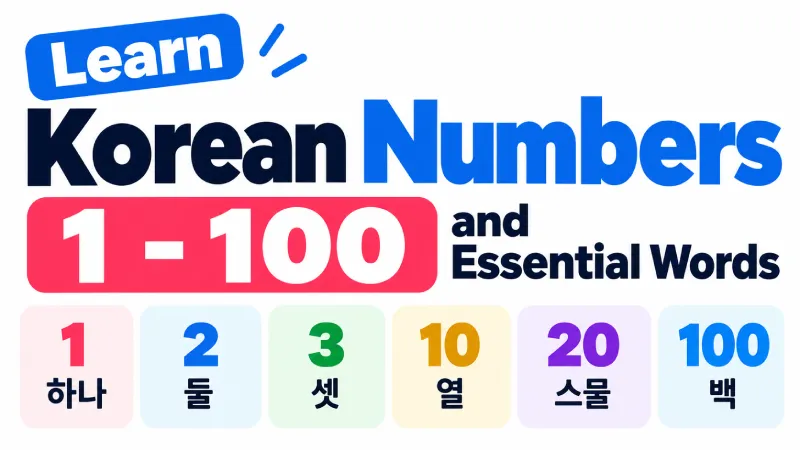
Learn Korean Numbers 1-100 and Essential Words

Learn Korean numbers 1-100 with Native Korean and Sino-Korean counting examples for beginners 복사

Learning Korean numbers 1-100 is one of the most useful skills for anyone studying Korean. You need numbers to talk about your age, tell the time, order food, shop in Korea, read prices, and understand dates. But Korean has a surprising feature: two different number systems. For example, the number 3 can be: Both mean … Read more

How to Say Hello in Korean: 15 Greetings for Beginners

How to say hello in Korean – 15 essential Korean greetings for beginners 복사 Image Title How to say hello in Korean – 15 essential Korean greetings for beginners

If you’re learning Korean, one of the first questions you’ll probably ask is how to say hello in Korean. The most common answer is 안녕하세요 (annyeonghaseyo), but Korean greetings are more interesting than just one word. The way you greet someone in Korean can change depending on their age, your relationship, and whether you’re meeting … Read more

How to Introduce Yourself in Korean (Beginner’s Guide)

How to introduce yourself in Korean – beginner's guide to Korean self-introduction 복사

Want to learn how to introduce yourself in Korean? Whether you’re visiting South Korea, meeting Korean friends, or starting your first Korean language class, a natural self-introduction is one of the most useful speaking skills you can learn. The good news is that you don’t need complicated grammar or hundreds of vocabulary words. With a … Read more